Every recruiter has typed a long string of AND, OR, and NOT operators, hoping the perfect candidate pops up. That is Boolean search, and for years it was the only real sourcing tool recruiters had. Now AI candidate search promises to find the same candidate in seconds, without the operators. So which method actually gets you a better shortlist? This guide breaks down Boolean search vs AI candidate search, how each one works, and which approach fits your hiring goals.
What Is Boolean Search in Recruiting?
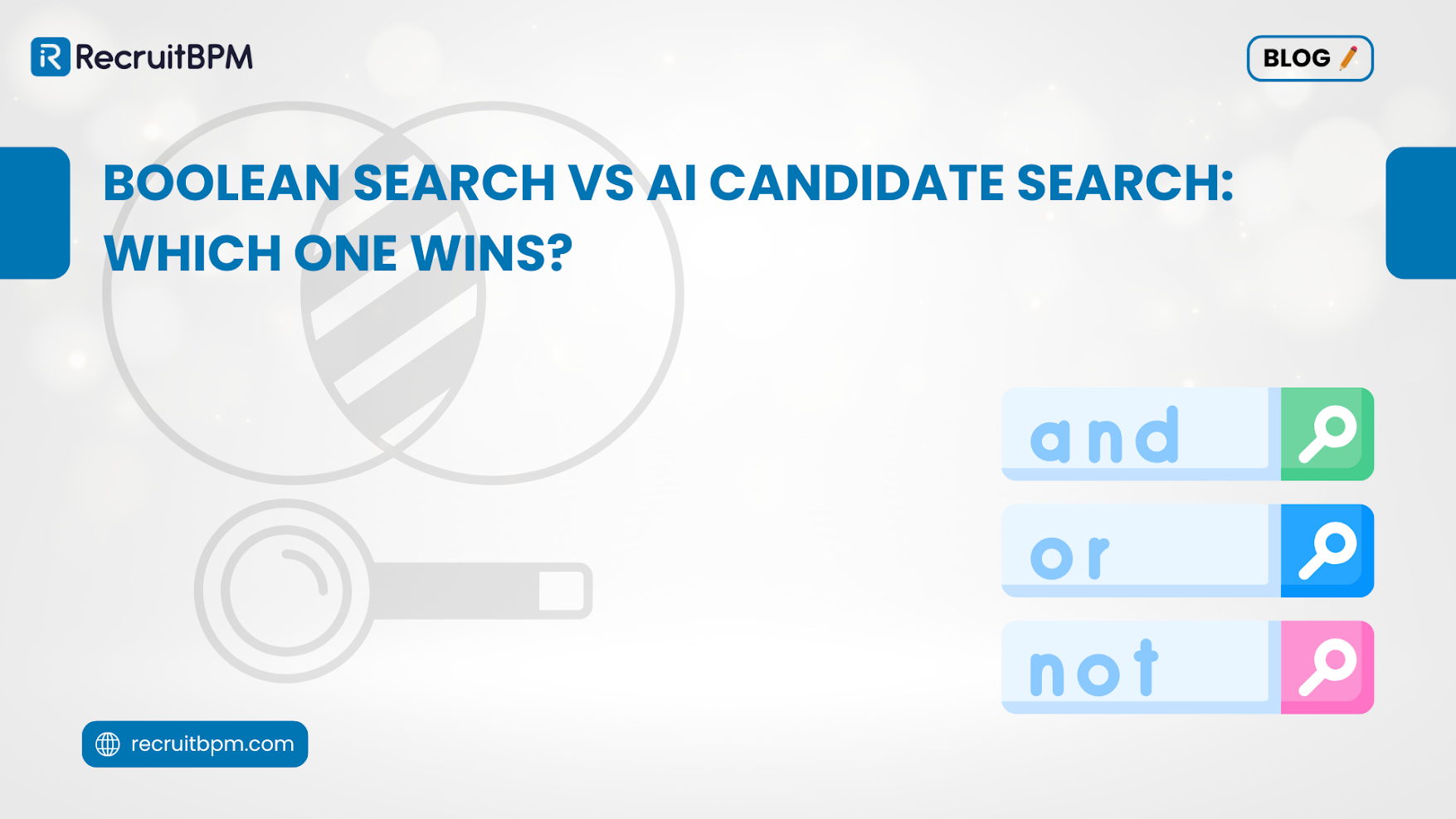
Boolean search is a method that uses logical operators like AND, OR, and NOT to combine or exclude keywords when searching resumes, job boards, or LinkedIn. It lets recruiters build precise strings such as (“project manager” AND agile NOT junior) to filter results down to a specific candidate profile.
Recruiters have relied on Boolean search since job boards and applicant tracking systems first went digital. It works because it forces you to think through every keyword variation a candidate might use on their resume, including job titles, skills, certifications, and even software names.
The catch is that Boolean search only finds what you literally type. If a candidate lists “people manager” instead of “team lead,” a poorly built string will miss them completely. Building a strong Boolean string also takes practice, and even experienced recruiters spend real time refining strings before they get usable results.
What Is AI Candidate Search?
AI candidate search uses machine learning and natural language processing to understand the meaning behind a search, not just the exact words. Instead of matching keywords, it matches context, skills, and intent, so a search for “customer success manager” can also surface candidates titled “client relationship lead.”
This works because AI models are trained on massive volumes of resumes, job descriptions, and hiring data. They learn which skills tend to cluster together, which job titles overlap across industries, and which candidates are likely to be a fit even when their resume uses different language than your job posting.
The result is a search experience that feels more like asking a colleague for a recommendation than running a database query. You describe what you need in plain language, and the system does the interpretation for you.
Boolean Search vs AI Candidate Search: Key Differences
Both methods aim to solve the same problem, but they get there in very different ways. Understanding the tradeoffs helps you decide when to reach for each one.
- Speed. Boolean search requires you to build and test strings manually, which can take several minutes per role. AI search returns ranked candidates almost instantly from a plain language query.
- Precision vs recall. Boolean search gives you exact matches, so results are highly precise but can miss qualified candidates who used different wording. AI search casts a wider net and often surfaces candidates a Boolean string would never catch.
- Learning curve. Boolean search demands ongoing skill building and string maintenance. AI search is designed for recruiters of any experience level to use immediately.
- Transparency. With Boolean search, you know exactly why a candidate matched, since you wrote the rule yourself. AI search results can feel like a black box unless the platform explains its ranking logic.
Is AI Candidate Search Better Than Boolean Search?
AI candidate search generally finds more relevant candidates faster than Boolean search, especially for roles with varied job titles or niche skill sets. Boolean search still wins when you need an exact, controllable match, such as a specific certification or a required legal qualification.
The honest answer depends on the role you are filling. For high volume, generalist positions, AI search saves hours by surfacing qualified people you would never have thought to search for by title. For highly regulated or technical roles where one wrong keyword changes everything, a carefully built Boolean string still gives you more control.
When Boolean Still Wins?
Boolean search remains the better tool when compliance requirements are strict, when you are searching a small internal database you already know well, or when you need to exclude specific terms with total confidence.
When AI Search Wins>
AI search wins when speed matters, when your talent pool uses inconsistent job titles, or when you want to surface passive candidates who would never rank highly in a keyword based search.
Can You Use Boolean and AI Search Together?
Yes, combining Boolean search and AI candidate search gives recruiters the best of both worlds. Use AI search to widen your initial candidate pool, then apply Boolean logic to filter that pool down to the exact requirements of the role.
This hybrid approach treats AI as the discovery layer and Boolean as the precision layer. You are no longer choosing one tool over the other, you are sequencing them so each one does what it does best, which shortens your time to shortlist without sacrificing accuracy.
How RecruitBPM Combines Boolean and AI Search?
RecruitBPM was built around this exact hybrid philosophy, so recruiters never have to choose between speed and precision. Our platform includes a full Boolean search builder alongside AI powered candidate matching, all inside one applicant tracking system.
You can run an AI search across your talent pool to surface hidden fits, then layer in Boolean filters to narrow that list down to candidates who meet strict requirements. Everything lives in one dashboard, so there is no switching between tools or exporting data between systems.
If your team is still relying on manual Boolean strings alone, you are likely missing qualified candidates every single day. Book a demo to see how RecruitBPM’s hybrid search works inside your own hiring workflow.
Choosing the Right Search Strategy for Your Team
Boolean search and AI candidate search are not rivals, they are two tools built for different moments in the sourcing process. Boolean gives you control and precision. AI gives you speed and reach. The recruiters who win the best candidates are the ones using both, not the ones stuck defending one method out of habit.
If you are ready to stop choosing between speed and accuracy, it is time to see what a hybrid platform can do for your pipeline.
Ready to search smarter, not harder? Book a Demo and see how RecruitBPM blends Boolean precision with AI powered candidate search, all in one platform.